Home

Sunday, 16 February 2014

A Year In Books (And A Lace Maker)

Dear readers,
I am delighted to share with you my February choice for A Year In Books organised by Laura at Circle Of Pine Trees.
Caramel tea is my favourite this month .  You may find it here
The year is 1683 and Robert Merivel, the main actor of Rose Tremain's Restoration (shortlisted for the Booker Prize in 1989), appears again, as melancholic and self-doubting as before.  The Puritan Revolution and Civil War have given way to the extravagance, gaity and desire for display which have revisted England with the return of Charles II from exile.  This is also a time of flux and uncertainty in every sphere; the perfect backdrop for Merivel's existence.  The son of a mere glovemaker, turned physician and natural scientist, and, more importantly, a close friend to King Charles II, who bestowed the imposing country estate of Bidnold in Norfolk upon him several years before.

Somewhat down in the dumps in the opening pages and surrounded by old, cranky and incompetent servants, Merivel is stung by Margaret, his beautiful daughter's, gentle reproach that he has become idle and that his life seems to lack purpose.  And so, in an attempt to seek glory, he decides to travel to London to his good friend Charles II with the aim of procuring from him a written introduction to The Sun King, Louis XIV, in Versailles.  Merivel's trip to France does not go as he had hoped but we, the readers, are treated to a  fabulous description of a palace under construction, the corridors of which are overspilling with malicious and desperate courtiers (many of which suffer the humiliation of sharing a "pisspot" and having little or no food) clutching at the hope of a moment's attention from a sneering and aloof king. 

A French château and a Swiss one, typhus, cancer, a duel, one miserable bear, lust, a father's love for his daughter, a profound friendship between a king and his physician, plenty of hot chocolate, and a smattering of gardens and, the most fabulous ingredient of all in my opinion; Merivel's touching self-deprecation which makes his excessive mood swings quite forgivable.  Rose Tremain's novel is as rich in material detail and it is in emotion.  I was quite simply enthralled and would strongly recommend it to you all.

I have gathered a lot of inspiration from reading Merivel and researching a little further the fashion of Charles II's court.  According to Aileen Ribeiro in her detailed book, Fashion And Fiction: Dress In Art And Literature In Stuart England, the king's preference was for 'subtle colours in his private costume, although the fabrics were rich and the linings often brightly coloured and pinked.'  In the painting below the king wears a plain coat and petticoat breeches of dark brown which brought to my mind the frequent cups of hot chocolate consumed by Merivel.
Hendrick Danckerts (attributed), Chalres II Presented with a Pineapple by the Royal Gardener John Rose, circa 1677.
Isaack Luttichys, Portrait Of Young Woman With Ostrich Feather In Her Hand, 1656
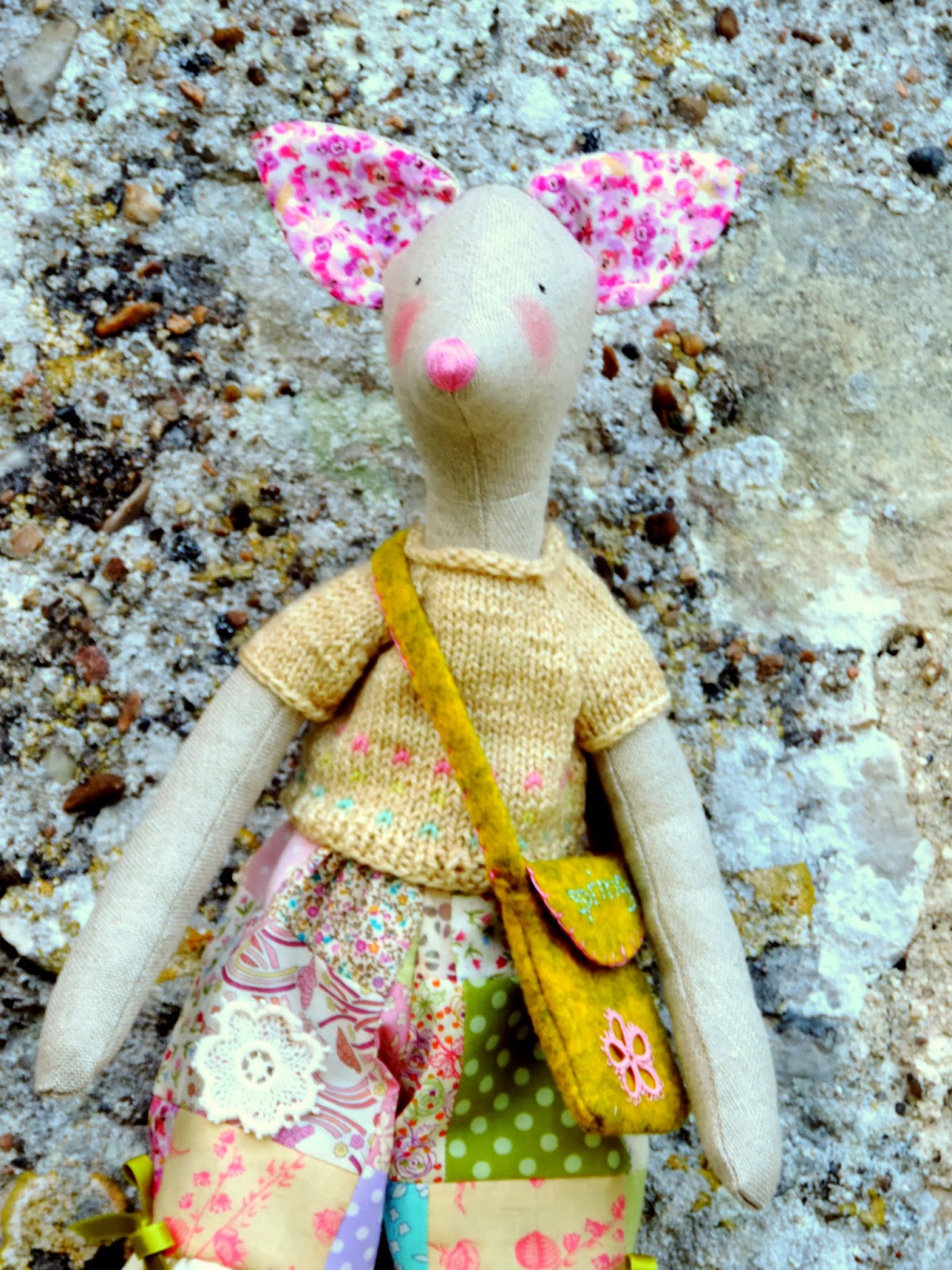
I wanted this latest hare of mine to wear the colours of the book - hot chocolate, starched laundry, arable earth and the browns of King Charles II's clothes .   She has also been greatly inspired by my friends who are passionate about lace making, both as collectors and creators.  I hope I've given her a timeless style.  Her pantaloons are stitched from my favourite 1900s hand embroidered polka dot tulle and trimmed with 1920s ivory lace.  The hem of her caramel-coloured dress is ornamented with a Breton friend's handmade lace.  As you can see she has a lace bobbin embroidered on one paw and on the other a lace thread spool.
I have named her Rosie Pierpoint after Merivel's favourite lover who runs a laundry by the Thames in London.  I must also confess that she is possible my favourite creation to date because of what she represents.  I love the art of lace making and I am very fond of the chocolate and caramel colours of her clothes too.  If you think you might like to give her a home you may find her here.
I leave you with a picture of our beloved eleventh-century parish church door where Rose Pierpoint was photographed today during a brief sunny spell.

May your week be filled with plenty of sunny spells too.

A bientôt,

Stephanie

Friday, 31 January 2014

The Spring Gatherer

Dear readers,
 
How may I thank all you kind souls who left sweet comments both here and on Ravelry concerning Tristan's winter pullover?  He was truly touched and most grateful and a little bit proud too which is a good thing as he can be quite self-effacing.  I read every word to him and watched him blush and glow.  A sight to behold.
Despite the unseasonally clement weather January has brought this year spring is not quite ready to limber up.  Timid bunches of naked green, which usually herald my favourite flower, the snowdrop, have not made their appearance yet.  However a couple of birds shared their demure song at dawn this morning and I felt most hopeful.  It was enough to fortify my heart after a mostly grey and damp week.  On Sunday I visited my favourite florist in the old part of Tours, after an enjoyable morning drinking coffee with new friends, and purchased a portly bunch of palest pink and white hyacinths to celebrate Angélique's fourth birthday on Monday.  It's a little tradition of ours.  Don't you think they set off this hat of mine well?  Rosewater is a delightful (and addictive) pattern which has been inspired by the famous Scottish architect and artist, Charles Rennie Mackintosh and his rose designs.  Rosewater, stylised roses, Madelinetosh DK yarn in the Molly Ringwald colourway - think of the 1980s film Pretty In Pink - all comprise delightful ingredients in my book!  
 
My Ravelry notes may be found here.
I often turn fondly to the copperplate engraving above when I need a little springtime inspiration and a splash of delicate colour.  I first came across it in the rare manuscripts department of La Bibliothèque nationale in Paris during my research on Baroque gardens and parterre designs a few years ago.  It is the frontispiece from Crispijn van de Passe junior's masterpiece Hortus Floridus first published in 1614; a Florilegium conceived against the backdrop of the Tulipomania which raged first across Holland and then spread swiftly to Europe until it died a violent death in 1637 due to its self-inflicted economic crisis.  Bulbous and tuberous plants were highly fashionable and the first part of this book, The Spring Garden, contains an exquisite collection of spring flowers many of which had been introduced to Europe towards the close if the sixteenth and during the early years of the seventeenth century.  Tulips, hyacinths, auriculas and crown imperials were rarities and treasured as though they were jewels at the time.  Equally prized at the time was French garden design and a few detailed engravings mark the beginning of each season in the book.
 
Hortus Floridus had a very complex genesis.  Each publication was unique as the production of the book was a continuous process with newly discovered plants being introduced from time to time.  It appeared in four languages: Latin, French, English and Dutch.  And most surprisingly the pictures, such as the frontispiece above, were to be coloured in by the owner:

"Hereby added the way in which the flowers according to their own colours should be painted or illuminated to the service of all curious lovers of flowers."
 
There is, if you are interested, a beautiful reproduction of an early twentieth-century edition which is available for purchase at a very affordable price here.
And the pictures above?  Well, the long-limbed creature is a doe who goes by the name of The Spring Gatherer.  She was my first creation this January and heralds the first throws of spring together with my newly acquired passion for patchwork which you can also see in its rudimentary glory in the doll's quilt I stitched for Angélique's fourth birthday gift - proficient patchworkers please avert your gaze!  I had so much pleasure making it; it's a flowerbed of sorts with a tiny embroidered mouse with armfuls of blooms - can you see it?  I mixed vintage French fabrics with scraps of Liberty but the BEST thing about this quilt is the handful of pink tatted lace flowers I have sown (yes, 'sown' not 'sewn').  They are the work of a remarkable Australian lady, Robyn, who gifted me the most exquisite lace I have ever clapped eyes on.  I will be taking more pictures of these beauties very soon to share with you.  Can you see one on The Spring Gather's bag?  When I look at Robyn's tatting I am lost for words at the perfection of those flowers and butterflies.  Can you believe she made them on a train journey to Prague and then Paris?
The weather may have been overcast but the week has been full of treasures.
 
I wish you all many happy moments over the next few days.
A bientôt,
Stéphanie

ps Will anyone else be joining in Laura's The Year In Books project for the first time in Feburary?

Friday, 17 January 2014

Delighting In Winter And The Boy

Dear readers,

Some folk cannot abide winter - there's too much talk of death in the garden - and grumble when temperatures hit zero.  Aside from the unpleasant truth of lurking stomach bugs and heavy colds I love it.  I don't consider winter a hardship.  It grants us many happy evenings of warm firelight and play (whether it be with yarn, musical instruments or playing cards), plenty of conversation and, just as importantly, another lens through which to see nature.  Winter is a time to observe the wood and the trees.  Barren branches against a pale blue sky are restful to the eye, and stunning too. The searching eye must prowl the wintery landscape learning the beauty of minimal colour palettes and stark silhouettes.

Here in the Loire Valley winter generally brings damp cold, rising water levels and precious little snow.  There is less sunlight of course (although this January, so far, we have been treated to a lot of sunshine) thanks to the slight tilt of the Earth, when rays strike at a shallow slant and the sun just doesn't feel as warm.  But when the frost strikes, or better still, snow falls, then childhood excitement returns as everything glitters like diamond dust and I find myself weaving fairytales both in my head and in our everyday life.
Mother Hulda (my version is a French adaptation), Jacob and Wilhelm Grimm's fairy tale, with its all-female cast, puts to the forefront the goddess of Pre-Christian German and Scandinavian folklore who single-handedly rules the weather; sunshine, snow and rain.  Mother Hulda is associated with spinning and weaving and in this wintery tale her cardinal role as patroness and guardian of all maidens is to shape the two sisters' destinies.  Mother Holle's eiderdown must be shaken thoroughly by a hard-working girl causing the feathers to fly about and the people in the world below to believe it is snowing.

And that slender, delicate maiden who has surely caught your eye above?  She is a winter fairy or, perhaps, a snowflake turned into the shape of a girl dressed in the finest white gauze with slippers sparkling like snow crystals.  She is also the work of the remarkable Verity Hope who paints, snow fairies aside, an evocate picture of life in sun-drenched Provence amidst the lavender fields.  I have wrapped her in tissue paper for Angélique's fast-approaching fourth birthday.
Finally, let us please turn to Tristan who does not get enough of a look-in both here and on Ravelry, averaging at around one pullover a year, poor child, which is quite shameful as I think about how palpable his excitement is when asked to chose a pattern and colour scheme for himself.  And as I observe him posing proudly for his photo session I marvel how such a dynamic, bouncy child can be so still and receptive to the camera unlike dear Héloïse who is always in movement thus causing many a blurred picture!  Dear Tristan, my guitar player and lover of anitque cars - or any car for that matter - is possibly the greatest weaver of stories in our family.  His imagination seems pretty boundless and his fountain pen nib scratches his ragged, hand-cut exercise books most weekend mornings. Perhaps, as Héloïse said recently, his tales are good because he strives to tell them without paying too much heed to perfection.  The odd spelling mistake or three will not hamper his enthusiasm!

He chose Veera Välimäki's High Water in Quince & Co.'s worsted-weight Lark in the wintery colourways; Frost and Winesap.The pattern is plain sailing except for the joining of the collar to the yoke which left me puzzled for more hours than I care to mention. Fortunately a fellow knitter living in Northern Norway, who is writing a thesis on brown bears, came to my help with a very useful diagram.   If you would like to read more about the simple techniques I acquired whilst knitting this pattern my Ravelry notes may be found here.
Happy weekend to you, dear readers! Thank you very much for all your kind comments which warm my heart.

A bientôt,

Stephanie

ps Would some kind knitting souls pop over to Ravelry here and leave a heart for Tristan, please?  For some strange and touching reason this son of mine attaches a lot of importance to how many hearts his pullover gets.  Thank you :-)


Friday, 3 January 2014

Rapunzel


THE TOWER
 The Rock of Manerba, Lake Garda, Italy - April 1595

A white flame of horror coursed through her.  'What are you doing?  What's happened to my hair?'

Slowly, [Margherita] began to realise that the hair was not all the same colour.  Some of the tresses were more red than gold, some more gold than red.  Some hung in tight twists and ringlets, some were smooth and silky, and others formed soft loose curls.  Each flowed and coiled into the next, like a river that ran one moment in quick rapids, then fell in a foaming roar, before winding in lazy loops into a tranquil pool.

'Hold still,' the sorceress said.  She was kneeling beside the bed, a long curved needle in one hand, threaded with fine golden filaments, a long flow of bronze-coloured hair in the other.  Each time she bound the hair, she chanted:

By the power of three times three, I bind you to me.
Thou may not speak of me, nor raise a hand to me
Nor stir from this place where I have cast thee.

It was as if her words wrapped chains around Margherita's wrists and ankles and tongue, fettering her.  She could not move or speak, though whimpers of terror struggled in her throat.

Kate Forsyth, Bitter Greens, p. 136.
Last summer, an amazing young lady named Claire, sent me a plump parcel full of exquisite yarns, the colours of which had been inspired by a card of Rapunzel my children had chosen for her. After a few months of casting on and unravelling a variety of promising patterns which I had hoped would do justice to the Rosy Cochineal silk and baby camel yarn I finally turned, for the third time, to Dani Sunshine’s Vintage Bouquet for which you will find my Ravelry notes here. Whilst knitting this shawl I embarked on a fascinating voyage into the origins of the Rapunzel fairytale thanks to Kate Forsyth’s, intriguing novel ‘Bitter Greens’ which, to my great delight, bought me, via late sixteenth-century Venice, full circle to the court of Louis XIV - the seat of my beloved late seventeenth-century aesthetics research.

I learned that the first version, written in 1634 by Giambattista Basile, was entitled Petrosinella; after the heroine's mother's craving for parsley not salad.  Charlotte-Rose de Caumont de La Force included her version, Persinette, in a collection of fairy tales published in 1697 during her bleak exile from the court of Versailles.  The final tale which most of us are familiar with is, of course, the Grimm brothers' Rapunzel which appeared in 1812

In Bitter Greens Charlotte-Rose de La Force's story becomes interwoven with the original strands of the Rapunzel tale.  She was an independently–minded woman from a noble family who caused several scandals in her quest to live a life that was self–determined. After publishing satirical works concerning King Louis XIV and an elopement with a minor Charlotte-Rose was exiled to a convent where she wrote her collection of fairy tales and a series of popular historical novels.  It is not hard to see why the story of a maiden locked away in a tower would appeal to her although scholars are puzzled as to how she gained access to the original Italian tale.

Instructive though it might be Kate Forsyth's novel is also the perfect companion for long winter evenings curled up in an armchair by the fire.  Three women, three lives and three stories are braided together in a compelling tale.  Have you read it?  If so I would love to have your opinion!  For those who might like to read the original Petrosinella I strongly recommend Jack Zipes's translation found in this book. Unfortunately, I cannot find an English translation of the French Persinette which is to be found in this collection.  I am pretty sure I will be laying my hands soon on this recent publication about the Rapunzel tradition.
And those boots?  They are, of course, the exquisite work of my favourite shoemaker, Ren from Fairysteps.  Unique, soft, light and built to last for many years.  I am absolutely certain I won't be bumping into another pair of feet in France as well shod as mine!  Rapunzel would have been grateful for such a comfortable pair of shoes once she broke free from her hellish confinement.
And because one fairytale often leads to another, here is the French artist, Miss Clara's, most recent work of art; The Princess And The Pea which is now available in English.

My most important message to each and every one of you, dear readers, is A VERY HAPPY, PEACEFUL, and MAGICAL New Year!  Oh, the undeniable thrill of a blank book waiting to be written.  Which begs the question; do you have any dreams for 2014?

Warmest wishes,

Stephanie 

ps With many thanks to Héloïse who posed under the rainclouds as a rather cheerful Rapunzel on New Year's Eve.  We had fun, didn't we?

ps I've just noticed that my shoes are featuring on Ren's Fairysteps header over here.

Saturday, 30 November 2013

Celebrating Change

Dear readers,

 Two e-mails of note arrived in our mail boxes this week.  The first stirred up feelings of intense maternal pride and the second, well, it just made me plain happy.

On Tuesday, whilst waiting for Héloïse to arrive home after dusk from her theatre class, I hesitantly logged into her account, as she had pleadingly requested the night before, and saw the mail she'd been waiting for.  Natural Sciences Interview, it read.  How could I not read on?  And then I jumped up and danced before my my younger children's surprised eyes: 'She's got an interview at Cambridge University', I shrieked!  Needless to say we all danced for quite a while after that.  And downed champagne too!  The interview will be taking place on Tuesday 17th December at Trinity Hall.
The second e-mail quietly landed in my mailbox yesterday.  It was short and terribly sweet.  My Phd thesis supervisor wrote that she would be delighted for me to return to complete my Phd thesis the following academic year.
 And with those few lines I felt as though I had returned home.

 Shortly after Angélique was born, almost four years ago, I was obliged to put my thesis to one side.  It was frustrating and it was the right thing to do at the time.  I cannot express how much I love my field of study - Baroque aesthetics - and how thrilled I am to have this chance to finish.  It is necessary too.  I have noticed the quality of my writing slipping and I need the guidance of my WONDERFUL supervisor who is brilliant and meticulous; two qualities we do not share!  It will be a tough, glorious year and I am so very excited.  So, change is afoot although it is not imminent.  It will change my perspective on creating too; of that I am certain.

To celebrate, in particular, Héloïse's good news, I slipped Miss Twinkle Toes onto my shop shelves today.  The last few weeks have been ridiculously and wonderfully busy with customer orders and I am happy to have had the time to put this little lady at least on sale before Christmas.  She is my last ballet-themed hare and is a bit of a celebration in herself: pink silk - called Rose Cherubin and sparkly linen purchased from Paris, ballet shoes and stars embroidered on her ankles with silver and silk threads.  My favourite thing was using The Uncommon Thread's wispy fingering merino yarn in the fairytale colourway; Spumoni to make her ballet wrap-cardigan.  It makes for delightful small-scale knitting on 2.75mm double-pointed needles!

If you think you know somebody who might like to give her a home you may find her right over here.

 I like change, mostly, although some would say I am not always so good at dealing with the unexpected.  How about you?  Do you revel or flee from change?  Have you made decisions already about next year?  I would like to read about them, big or small.

A bientôt,

Stephanie


Related Posts Plugin for WordPress, Blogger...